Friday, December 27, 2013

Patterson's Pellet, Minnewaska

So, a couple of days ago I went on a hike at Lake Minnewaska State Park in the Shawangunks.

One of the interesting geologic features at the park is a large glacial erratic called Patterson's Pellet.  It's a dramatic feature along Millbrook Mountain Carriage Road where it's perched atop the cliffs above Palmaghatt Ravine.

 
Here's a picture from the backside (I climbed a short distance down to a ledge).  Another foot or two to the left and the erratic would never have lasted atop the cliff.
 
 
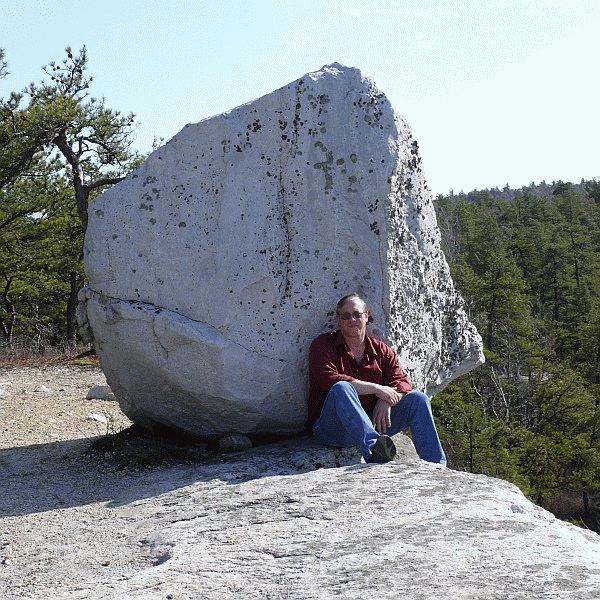
Here's a bad self-portrait (I was hiking alone) by placing the camera on the ground (and into the Sun!).  As you can see, the rock is about 6 x 6 feet in size.


Here's a picture of Patterson's Pellet from the other side of Palmaghatt Ravine (a place called Kempton Ledge on Castle Point Carriage Road).


 So what's a glacial erratic?  I've posted about them in the past (like North Salem Balanced Rock).  They're simply rocks that were picked up by the glaciers during the last ice age.  When the glaciers melted some 12,000-10,000 years ago in the Hudson Valley, the rocks entrained within the ice simply dropped out.  Some, like North Salem Balanced Rock and Patterson's Pellet, dropped out in interesting ways.

I'm 18 of 105 Geology Websites that Rock

So, I was listed on Geology Online: 105 Websites That Rock.  Number 18 out of the 105 websites.  There's some other interesting stuff there as well, it's worth a look around.  Including the blogs they chose is part of a marketing strategy since the site obviously exists to advertise various for-profit colleges which, as a traditional academic, I have reservations about but caveat emptor and all that.

Monday, December 16, 2013

The Density of the Earth

In my previous two posts, I described how the ancient Greek Eratosthenes calculated the circumference of the Earth by an observation of shadows on the summer solstice in 200 BCE and how English scientist Henry Cavendish calculated the mass of the Earth from a simple torsion balance in the late 1700s.  Go and read them here and here if you haven't already.

Once you know the mass and size of the Earth you can calculate its density.

Density (abbreviated with the Greek letter rho - r), is mass per unit volume (g/cm3 or kg/m3 are common units).  Imagine a block of steel and a block of cheese the same size.  The steel will weigh more and thus have a higher density (steel is about 8 times the density of cheese!).

Steel vs. cheddar cheese (not quite the same size)

So what is the density of the Earth?  Well, let's start with the circumference of the Earth which Eratosthenes has shown can be measures.  We'll use an average value of 40,075 km.  From this, we need to calculate the volume of the Earth.  The formula for the volume of a sphere is:

   V = (4/3) p r3

and the radius (r) is:

   r = C / 2 p

Substituting yields:

   V = (4/3) p (C/2p)3

Simplifying and solving:

   V = C3 / 6 p2 = (40,075 km)3 / 6 p2 = 1 x 10¹² km3

What about the mass of the Earth?  Well that was calculated by Cavendish and we can use the modern value of 6 x 1024 kg.

Now finding the density is easy (don't even need a calculator):

   r = m / V = (6 x 1024 kg / 1 x 10¹² km3) = 6 x 10¹² kg/km3

This rather nicely converts to 6 g/cm3 (a more exact modern value is 5.515 g/cm3).

So the average density of the Earth is about 5.5 g/cm3.   This poses a problem, however.  It turns out that the average density of crustal rocks is around 2.7 g/cm3 (the density of the mineral quartz which is a major constituent of many rocks).  So where is all this extra mass coming from to give this higher density?


It turns out that the center of the Earth has an iron core.  Iron has a high enough density (over 7 g/cm3) to bring the average density of the Earth up to its calculated value.

Even though we've never directly sampled the core of the Earth, there is other evidence to support the hypothesis of an iron core.  These include the fact that iron is an abundant element in the solar system (ever hear of iron meteorites?), the speed of seismic waves through the core match what's predicted for it being composed of iron, and we have a magnetic field that's generated by the movement of liquid iron in the outer part of the core.

It's pretty cool how an ancient Greek, an 18th century British scientist, and our knowledge of the interior of the Earth are all part of an interrelated story.

Sunday, December 15, 2013

Cavendish Weighs the Earth

http://hudsonvalleygeologist.blogspot.com/2013/12/eratosthenes-measures-earth.htmlIn my previous post, I described how the ancient Greek Eratosthenes measured the size of the Earth.  Today I'd like to talk about how you can calculate the mass of the Earth.

Henry Cavendish (1731-1810) was a British scientist who made several important contributions to chemistry and physics.  He was born into an aristocratic family and his family wealth and frugality allowed him the freedom to devote himself to his academic interests.

Cavendish was also notoriously eccentric.  He reportedly spoke in a "shrill, high-pitched" voice and hated talking to people.  He left notes to communicate with his servants and built a special staircase in his home for them so that he wouldn't have to see or speak with them.  If someone did manage to corner him for a chat, Cavendish would reportedly issue a "peeved squeak" and scurry off to escape the social encounter.  His anthropophobia (fear of people) was particularly acute with women - he apparently never had a relationship or married.  Neurologist Oliver Sacks has suggested that Cavendish suffered from Asperger Syndrome.

Cavendish was also noted for his odd manner of dress.  He was known for always wearing a faded violet coat and three-cornered hat.  Clothes that had been out of fashion since his grandfather's time.  When one pair wore out, he simply commissioned someone to make another set.

Cavendish's stately home in Clapham Commons (just outside of London)

The only place Cavendish ever interacted with people outside of his home was when he regularly attended the weekly dinners and meetings of the Royal Society.  There, he lost his inhibitions when discussing his scientific work and was highly respected by his peers despite his eccentricity.

Cavendish is perhaps best known for the eponymous Cavendish experiment which he published in 1798.  He started by constructing a torsion balance which consisted of two separate suspension systems.  One held two 12-inch lead balls that weighed almost 350 pounds each.  The other system held two smaller 2-inch lead balls (weighing about a pound and a half each) attached to the ends of a six foot wooden rod which could rotate freely.  The two smaller lead balls were located about 9 inches away from the much larger weights.  As these masses attracted each other (by the force of gravity), the wire suspension system would twist (hence the name torsion balance).

Cavendish built the balance in an outbuilding on his property and meticulously measured the deflection of the masses and calculated a value for G - the gravitational constant.

Published figure by Cavendish of his torsion balance
 
Reproduction in the Science Museum, London
 
At right below is a simplified diagram of the experiment.  The formula for calculating the gravitational constant (G) from this setup is the following:
 
   G = [(2 p2 L r2) / (M T2)] q
 
Where L is the length of the rod holding the two smaller masses, M is the mass of the large balls, r is the distance between the large and small balls, q is the angle of deflection, and T is the resonant oscillation period (time units) of the balance (basically a measure of how easily the wire twists and related to k, the torsion coefficient of the wire).

Cavendish obtained a value for G of 6.74 × 10⁻¹¹ m3 kg−1 s−2.  This value is only about 1% off from the value we use today.  If you're interested in the mathematics, the Wikipedia article on the Cavendish experiment has the derivation.

From G, and the Law of Universal Gravitation developed by Isaac Newton one hundred years earlier, Cavendish could then calculate the mass of the Earth by the formula:

   MEarth = [(g REarth2) / G]

Where MEarth is the mass of the Earth, REarth is the radius of the Earth (obtained from Eratosthenes), g is the acceleration of gravity (9.8 m/s2), and G is the gravitational constant.

From this experiment, Henry Cavendish was able to "weigh the world."  Amazing!  Now that we know the size of the Earth from Eratosthenes, and the mass of the Earth from Cavendish, we can calculate the Earth's density and that tells us something interesting about the unseen interior of our planet that I'll discuss in my next post.