Tuesday, January 3, 2012

What is a Mineral? (Part 2)

Yesterday, I started talking about the geological definition of a mineral. I had gotten through 3 of the 5 characteristics a mineral must possess - minerals are naturally-occurring, inorganic, and solid. Today I'll cover the final two characteristics - minerals have an orderly crystalline structure and a well-defined chemical composition.

Look at the image below. On the left is a nice amethyst crystal. No one would deny that this is crystalline. On the right is a piece of kaolinite - a soft, powdery clay mineral. Is this crystalline? Turns out it is indeed crystalline.


Crystalline does not mean it only occurs as a crystal, crystalline means that the atoms which link together to form the mineral do so in an orderly, repeating, fashion.  This mineral quartz and silica glass, for example, both can be denoted by the formula SiO2 - the difference is that in quartz, the silicon and oxygen atoms are linked up in a hexagonal lattice.  In glass, they're linked together, but not in a regular repeating fashion.  Glass is therefore not crystalline.


Back to the lump of kaolinite clay (Al2Si2O5(OH)4) above.  It actually has a crystalline structure as shown below (it's a bit complicated and difficult to see in 2-D).


The final characteristic of minerals, having a well-defined chemical composition, sound simple but also has some complications we can mention.  Most common minerals have simple chemical formulas - gold (Au), halite (NaCl), quartz (SiO2), calcite (CaCO3), hematite (Fe2O3), and orthoclase feldspar (KAlSi3O8) are examples.

Other minerals, however, have formulas that are a bit more odd looking. One fairly common mineral, called hornblende, has a formula that may be written as:

(Ca,Na)2–3(Mg,Fe,Al)5(Al,Si)8O22(OH,F)2

It's not an exact formula.  It can have varying amounts of different elements. Is that really a well-defined chemical formula?  I guess so since hornblende is a mineral.

So there it is.  To a geologist, a mineral is "any naturally occurring inorganic solid that possesses an orderly crystalline structure and a well-defined chemical composition."

One oddity of this definition, by the way, is that ice should be considered a mineral.  It's naturally-occurring, inorganic, solid (certainly tonight here in the Hudson Valley since it's 11° F out right now), has an orderly crystalline structure, and a well-defined chemical compositon (H2O).

Monday, January 2, 2012

What is a mineral? (Part 1)

What is a mineral?  Ever play the game 20 Questions?  In that guessing game, the first thing established is whether or not the mystery object is an animal, vegetable, or mineral.  In this case, the term mineral refers to anything inorganic (a coin in my pocket, for example, would be a "mineral").  This is not, however, how a geologist would define a mineral.

Every morning I take a multivitamin with minerals.  The "minerals" listed are things like iron (Fe), copper (Cu), magnesium (Mg), selenium (Se), zinc (Zn), and others.  Geologists would call these things elements, since they're found on the Periodic Table of the Elements, not minerals.

If you've ever taken a geology course, you should already be aware that geologists have a very specific definition for the term "mineral".  Let's look at that definition.

From Tarbuck & Lutgen's Earth Science (2012, 13th ed., Prentice-Hall), a standard college-level earth science text for non-science majors, a mineral is defined as:

...any naturally occurring inorganic solid that possesses an orderly crystalline structure and a well-defined chemical composition.

Let's look at each part of this definition in a bit more detail.

Minerals are naturally-occurring.  This means that anthropogenic ("man-made") materials, like synthetic gemstones for example, are not minerals.  Diamonds (C) are naturally-occuring minerals while cubic zirconia (ZrO2) are made in the laboratory and not considered to be true minerals.  Can you tell which is which in the image below?


Some definitions, however, limit this a bit more.  The International Mineralogical Association, for example, defines a mineral as:

...an element or chemical compound that is normally crystalline and that has been formed as a result of geological processes.

In this definition, biogenic compounds - those created by living things - are not minerals.  Examples include things like the kidney stones (calcium oxalate - CaC2O4) shown at left and bivalve shells (aragonite - CaCO3).

The textbook definition, however, would consider these thing to be minerals.  Keep in mind that terms like "minerals" are defined by people (kind of like the term "planet" in astronomy) and people disagree about the definitions at times!

Minerals are inorganic.  Here it gets all complicated too.  Turns out there really isn't any formal chemical definition of the terms organic and inorganic.  Generally speaking, however, inorganic compounds aren't organic compounds.  OK, so what are organic compounds?  Organic compounds are basically carbon atoms bonded together with attached hydrogen, oxygen, or nitrogen atoms.

As an example, both salt (left) and sugar (right) look crystalline under magnification.  The difference is that salt is NaCl which is an inorganic molecule whereas table sugar (sucrose) is C12H22O11 - an organic molecule.

 
Minerals are solid.  The state of a material (solid, liquid, or gas) obviously depends on temperature and pressure conditions so, once again, we have to clarify things a bit more.  Generally, we specify that a mineral must be solid at the range of temperatures and pressures found on the Earth's surface.  We can even be more precise and specify 1 atmosphere of pressure at 0° C (STP) or 1 atm at 20° C for room temperature.

Minerals also have an orderly crystalline structure and a well-defined chemical composition.  I'll come back to these tomorrow...

Sunday, January 1, 2012

Unseasonably warm weekend ramble

It's been unseasonably warm this New Year's weekend getting up to 50+ degrees yesterday and today.  Went for a walk on Saturday - here's a few pictures and observations from my ramblings...

We've had so much rain this fall that the ground is completely saturated.  Any rain falling now sits on the surface without even soaking into the ground - even several days later.  Here's a view of Undivided Lot Trail on the Mohonk Preserve - a wet, mucky mess.  This part of the trail is always bone dry.  We only had about 0.7 inches of rain four days earlier on Tuesday.

Once we enter the deep freeze of January and February, all of this supersaturated ground will frost heave terribly.  Expect badly broken up roads this winter (and a perpetually-broke County and State slow to repair them).  Also expect flooding in the spring when the snow melts.  Worst case scenario - heavy snow pack, warming in early March, and a heavy rainfall from a slow-moving nor'easter for a couple of days.

I've walked past the following beech tree hundreds of times before (the trail is one of my favorites in the local area).  Never noticed how unhappy it looked.


The trail is also popular with crows, ravens, and vultures.  The vultures are probably sunning themselves in Florida now but the crows were especially vocal and active (didn't hear any ravens - not sure if they winter here).  Here's a flock of crows flying toward the south (probably just to roost somewhere since it was late afternoon).


Crow stopping to rest...


See the white dot above the center tree in the flock of crows picture? That's the first-quarter Moon rising in the east.  Here's a close-up view.  Ever since teaching Ancient Astronomy, I've become much more aware of the phase of the Moon.


I like cliffs and pitch pines.  Don't you just want to walk out along that ledge?


It's a long way down.  Ever stand on the edge of a cliff and wonder what it would feel like to launch yourself off?   I'm envious of birds sometimes.


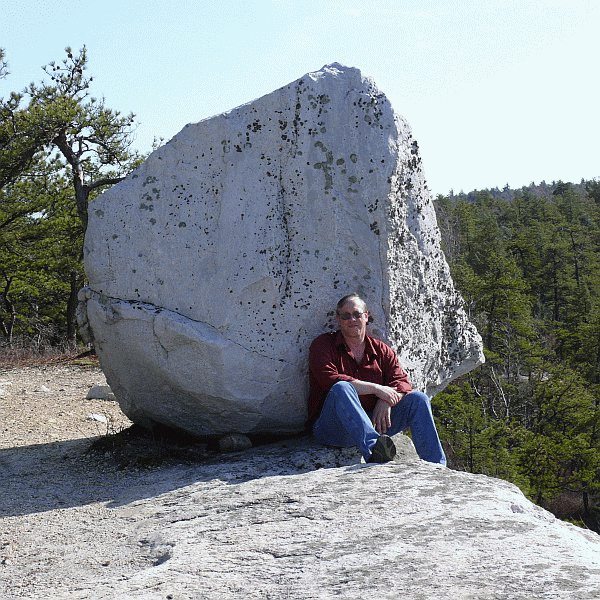
Here's a good place to sit and contemplate things.


I mostly like to sit where I can dangle my feet of the edge...


I feel fortunate I only live 5 minutes away from this trailhead (and have a yearly membership to the Mohonk Preserve) so I can hike there whenever I need to get out and commune with nature.

I'll close with a shot of the winter Sun, low in the southwestern sky.  Since we've passed the solstice, every day that Sun will get a little higher and a little stronger!


Happy New Year

It's officially 2012.  Happy New Year everyone and may it be a better year than 2011!

I've been blogging for two years now - my first post was on December 29, 2009.  In that time, I've had 502 posts (an average of one post every 1.5 days - not bad!).  I've also had, as I write this, over 89,000 unique visitors and my stat counter says I generally have over 200 unique hits each day.  Not bad for a blog I don't really advertise in any way.

It's funny keeping a blog because sometimes I love writing and have multiple posts I could do each day and other times I'll go for a week or more and can't really think of anything I want to write about.  Usually, once I start writing, however, I can keep going - the trick is in starting!

Notice that I don't have any advertisements on my blog - it's entirely commercial free (other than occassional links to Amazon when I mention books).  That's by intent.  Sometimes people send me unsolicited requests to set up advertising on my blog.  I delete those emails.  I really despise how some very good blogs are completely cluttered up with intrusive advertising (including obnoxious pop-ups).  I've even quit reading some blogs because they load so slowly with all the crap running on them.

I also generally write about only what I want to write about.  Sometimes I get emails suggesting things to write about and I generally ignore those too.  If you pay me, I'll write what you want me to write.  Otherwise, I do what I want.

Guess I'll keep it up for a while longer...