

 Unique Visitors
A local education issue...
From a June 29, 2012 Kingston Daily Freeman article:
"The college president has said about 60 percent of UCCC freshmen need to take remedial math and 40 percent need to take remedial writing, though the numbers vary from year to year."
UCCC refers to Ulster County Community College here in the mid-Hudson Valley. Most students coming into our community college are simply not able to do college-level work (college-level English and math skills are foundational for all of the science courses I teach, for example).
The article states in the very next sentence:
"And the state Education has reported that only 28 percent of Kingston High School students in the last two graduating classes were fully prepared for college and/or careers, as measured by their performances on math and English Regents exams."
Many of UCCC's students come from the Kingston school district. The article went on to discuss the college can work with the high school to improve student's readiness for college. I have no problem with that - it's a good thing.
As a taxpayer, however, I do have a problem with local public schools (Kingston is not unique). The Kingston City School district spends $17,624 per student each year. The problem is not a lack of money. The problem is a lack of accountability. Not from the teachers - the teachers are accountable to students, parents, administrators, the State Education Department, and the federal Department of Education in many and various ways.
No, I'm talking about holding the students accountable. If only 28% of Kingston High School students in the last two graduating classes were fully prepared for college and/or careers, as measured by their performances on math and English Regents exams, perhaps only 28% should graduate with a diploma. Damn the students and parents who would undoubtably raise hell and blame everyone but their precious snowflakes. If you start with fucking kindergarten, it would be a part of the expectations. No going to 1st grade until you learn the alphabet. No going to 2nd grade until you can read simple books and add numbers together (or whatever it is that 1st graders should know).
Then again, maybe this is obvious to me since we homeschool our kids. We don't use a lot of formal curricula, but we do use one for math (Saxon). If one of my kids gets a 75% on a math test, we don't just move on (like you do in a public school classroom), we go over everything again to make sure it's understood. This is necessary because math is cummulative. If you have a gap in your knowledge about the Revolutionary War, you can still learn about the Civil War. If you have a gap in your knowledge about fractions, it will keep coming back to bite you in the ass with successively higher level math courses. With English skills, I believe it's because many kids today simply don't read. The very idea of reading a book for pleasure is a foreign concept. If you don't read anything other than ungrammatical text messages, you won't be able to write well.
Knowledge builds on itself. Without a good foundation, it just gets worse and worse each year and then our community college is supposed to take someone with a 6th grade reading level (when they read, which they don't) and who thinks fractions are advanced math, and remediate them in one or two semesters such that they can be a college student. Add to this the fact that many of these students aren't even motivated to be there - they hate learning and education and will tell you that. It's not surprising that it typically doesn't work. While there are a few success stories, many of these remedial students use up multiple semesters of mom & dad's money, financial aid, and student loans to finally drop out with a transcript full of W, F, and D grades.
Some students are shocked that they can't pass a course simply by showing up because that's how it worked in their high school. I'm not exaggerating - students have told me this directly. I've been told by a teacher at a local middle school that they are not allowed to fail kids more than once. Even if they completely deserve to fail. I've been told by another teacher that her distict superintendent initated a discussion on doing away with failing grades altogether - teachers would not be allowed to give a student an F. In other words, students can not fail not matter what they do (or, more accurately, don't do).
By our shortsighted and permissive educational policies, our fear of offending anyone or holding them accountable, we're dooming a generation of kids to a life of ignorance and stupidity. We will reap what we sow.
Saturday, June 30, 2012

Friday, June 29, 2012
Obsidian - Part II
So yesterday I wrote a bit about the igneous rock obsidian. I finished by mentioning how obsidian devitrifies over time by hydration when exposed to atmospheric water vapor. One of the results of this devitrification is the mineral cristobalite.
The formula for cristobalite is SiO2. Here's where it can get a little confusing. I mentioned in yesterday's post that obsidian was made of silica or SiO2. But it's in the form of amorphous glass which means the silicon and oxygen atoms aren't arranged in a regular repeating (crystalline) lattice throughout the rock because it cooled too quickly for the atoms to arrange that way.

SiO2 is also the formula for the common mineral quartz. In this case, the silicon and oxygen atoms are arranged in a regular repeating fashion forming a crystalline structure (not necessarily a nice quartz crystal, even a lumpy irregular mass of quartz has a crystalline structure).

Anyway, when cristobalite forms in obsidian due to devitrification, it typically forms white splotchy masses scattered through the rock that look like snowflakes - hence the name snowflake obsidian.


 As obsidian keeps hydrating and devitrifying, over hundreds of thousands to millions of years of exposure on the Earth's surface, it eventually decomposes into perlite. Many of you have probably heard of perlite since it's often mixed with soil to improve hydration and aeration.
Perlite is also amorphous volcanic glass, like obsidian, but hydrated with a lot of water. When you heat raw perlite to 850–900 °C, it softens (because it's glass) and the trapped water vaporizes and escapes expanding the material by over 10 times its original volume resulting in low density, pH-neutral, bright white "rock" which is then ground into various sizes for different uses.
Perlite is not only used as a soil additive, it also has tons of other industrial uses as a filler, insulator, aggregate, and abrasive.
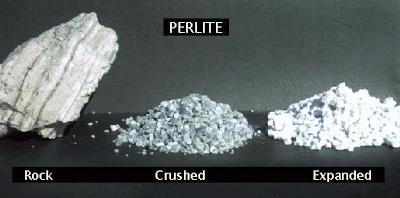
Within deposits of perlite, you can sometimes find left-over nodules of obsidian (snowflake obsidian typically) which are called Apache tears when they're found in Arizona/New Mexico.


The "legend" part is the formation of the obsidian. In the winter of 1870, Company B of the Arizona Volunteers did apparently corner a band of Apaches on top of Big Picacho (Apache Leap Mountain) resulting in a number of them leaping to their deaths rather than die at the hands of the U.S. cavalry.
The formula for cristobalite is SiO2. Here's where it can get a little confusing. I mentioned in yesterday's post that obsidian was made of silica or SiO2. But it's in the form of amorphous glass which means the silicon and oxygen atoms aren't arranged in a regular repeating (crystalline) lattice throughout the rock because it cooled too quickly for the atoms to arrange that way.

A piece of obsidian I have laying around - SiO2 glass
SiO2 is also the formula for the common mineral quartz. In this case, the silicon and oxygen atoms are arranged in a regular repeating fashion forming a crystalline structure (not necessarily a nice quartz crystal, even a lumpy irregular mass of quartz has a crystalline structure).

Crystalline quartz (SiO2) even though they're not crystals
Cristobalite is also SiO2. In this case it is also a mineral, like quartz, but with a different crystalline structure because it's stable at higher temperatures (above 1,470° C) but can exist in a metastable state at Earth surface temperatures and pressures. We call minerals, like quartz and cristobalite, that have the same chemical formula but different crystalline structures, polymorphs. The mineralogy of cristobalite is complicated (read about it here) so I'm not going to even attempt more of an explanation here (by the way, there are also other polymorphs of SiO2 besides quartz and cristobalite).
Anyway, when cristobalite forms in obsidian due to devitrification, it typically forms white splotchy masses scattered through the rock that look like snowflakes - hence the name snowflake obsidian.

Cristobalite in snowflake obsidian
Snowflake obsidian is quite attractive when polished and you can find examples of worked snowflake obsidian at any rock and mineral show.

Examples of snowflake obsidian carvings
 As obsidian keeps hydrating and devitrifying, over hundreds of thousands to millions of years of exposure on the Earth's surface, it eventually decomposes into perlite. Many of you have probably heard of perlite since it's often mixed with soil to improve hydration and aeration.
Perlite is also amorphous volcanic glass, like obsidian, but hydrated with a lot of water. When you heat raw perlite to 850–900 °C, it softens (because it's glass) and the trapped water vaporizes and escapes expanding the material by over 10 times its original volume resulting in low density, pH-neutral, bright white "rock" which is then ground into various sizes for different uses.
Perlite is not only used as a soil additive, it also has tons of other industrial uses as a filler, insulator, aggregate, and abrasive.


For some reason, I have a whole bowl-full of Apache tears at my house and I have no memory of where I got them (other than I did not collect them and probably bought them at a rock show). Here is a sampling.

According to Wikipedia: "The name "Apache tear" comes from a legend of the Apache tribe: about 75 Apaches and the US Cavalry fought
on a mountain overlooking what is now Superior, Arizona in the 1870s. Facing
defeat, the outnumbered Apache warriors rode their horses off the mountain to
their deaths rather than be killed. The wives and families of the warriors cried
when they heard of the tragedy; their tears turned into stone upon hitting the
ground."

Apache Leap Mountain, Superior, AZ
The "legend" part is the formation of the obsidian. In the winter of 1870, Company B of the Arizona Volunteers did apparently corner a band of Apaches on top of Big Picacho (Apache Leap Mountain) resulting in a number of them leaping to their deaths rather than die at the hands of the U.S. cavalry.
Science and culture (yes, Johnny Cash is culture).
Thursday, June 28, 2012
Obsidian - Part I
 Sometime between 77-79 CE, the Roman naturalist Pliny the Elder (Gaius Plinius Secundus, 23-79 CE), published Natural History (Naturalis Historia) - a massive tome which attempted to cover the entire field of ancient knowledge. It was, in essence, the first encyclopedia.
One of the sections in Natural History dealt with glass and Pliny mentioned the following:
"Among the various kinds of glass, we may also reckon Obsian glass, a substance very similar to the stone which Obsius discovered in Æthiopia. The stone is of a very dark colour, and sometimes transparent..."
The term obsianus lapis "stone of Obsius" eventually morphed into our English word obsidian and refers to naturally-formed volcanic glass - a type of igneous rock.

 While obsidian wasn't written about until Pliny, it was known to humans and quite possibly by our hominid ancestors like Homo habilis as well. This was due to a property known as conchoidal fracture - from the Greek κογχε (konkhē) which means "mussel" after the ridges on a mussel shell. Obsidian, being a glass, is amorphous which means it doesn't have an underlying crystalline structure and will typically break along a curved, ridged fracture surface (similar to other natural materials such as chert or flint). The edges of these fractures can be sharper than surgical steel scalpels.
Obsidian is widespread and associated with certain types of volcanic eruptions where it forms by the fast cooling of silica-rich (rhyolitic) magma.

Obsidian is found in many areas around the world including most of the Western U.S. states.

One interesting fact about obsidian is that each eruptive occurrence is slightly different with regard to trace amounts of various elements in the source magma. This provides obsidian from a specific locale with a unique chemical signature and allows archaeologists to trace obsidian tools to specific quarries which, in many cases, reveals ancient trade routes.
Obsidian is typically 70% or more amorphous SiO2 (silicon dioxide) with smaller amounts of other elements. These elements form microscopic minerals wihich color the obsidian black but there are variations of brown, gray, green, gold, and even reddish (mahogany obsidian). This leads to another interesting property of obsidian in that it breaks down over time by a process called devitrification which is caused by hydration - the absorption of atmospheric water vapor.

Because obsidian alters over time (dependent on temperature and water available), this process can be used to roughly date obsidian samples and artifacts. It also means that it's rare to find obsidian over 20 million years or so ago and there is no obsidian in the geologic record older than the Cretaceous Period (65-145 million years ago).
Tomorrow I'll talk about what forms from devitrified obsidian.

One model for the emplacement of obsidian by Fink, J.H. (1983) GSA Bulletin 94 (362-380)
Obsidian is found in many areas around the world including most of the Western U.S. states.
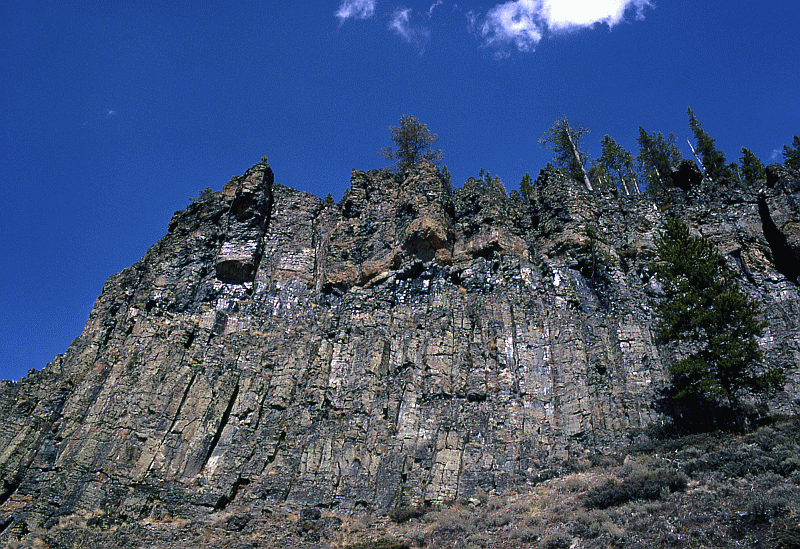
Obsidian Cliffs in Yellowstone National Park, Wyoming
One interesting fact about obsidian is that each eruptive occurrence is slightly different with regard to trace amounts of various elements in the source magma. This provides obsidian from a specific locale with a unique chemical signature and allows archaeologists to trace obsidian tools to specific quarries which, in many cases, reveals ancient trade routes.
Obsidian is typically 70% or more amorphous SiO2 (silicon dioxide) with smaller amounts of other elements. These elements form microscopic minerals wihich color the obsidian black but there are variations of brown, gray, green, gold, and even reddish (mahogany obsidian). This leads to another interesting property of obsidian in that it breaks down over time by a process called devitrification which is caused by hydration - the absorption of atmospheric water vapor.

Mahogany obsidian from Mexico
Because obsidian alters over time (dependent on temperature and water available), this process can be used to roughly date obsidian samples and artifacts. It also means that it's rare to find obsidian over 20 million years or so ago and there is no obsidian in the geologic record older than the Cretaceous Period (65-145 million years ago).
Tomorrow I'll talk about what forms from devitrified obsidian.
Wednesday, June 27, 2012
Local Hike
It was such a nice day today (around 82° F with low humidity) that I decided to take an afternoon hike with my family to a place called Duck Pond on the Monhonk Preserve (I have a membership).
View Larger Map
It's a pretty, man-made (although a long time ago so it's hard to tell it's not natural) pond nestled on the shoulder of the northeastern Shawangunk Ridge.

It's a short easy hike and nice for kids since you can sit on some log benches next to the pond and see some wildlife. No ducks, but last time we were there we saw a large, ancient-looking snapping turtle (Chelydra serpentina). Not around this time but we did see a lot of small fish (we fed with crumbs) and a northern water snake (Nerodia sipedon) with beautiful patterning. The snake swam completely across the lake and looked to be about 4 feet in length.

Lots of common white tail dragonflies (Plathemis lydia) around (among others). They were having aerial sex (my kids thought they were fighting each other).

There are also some huge snails (Bellamya chinensis) amongst the algae at the edge of the pond. Thousands of them, actually. The snails are an interesting story, they're introduced "Chinese mystery snails" originally brought to the San Francisco prior to 1900 by Chinese immigrants as a delicacy. They then became popular as aquarium snails and were first seen in the northeast around 1940. Here's a paper on them.

Also saw some creepy-looking doll's eye (Actaea pachypoda) plants. I've written about them before. Later on, the berries will turn white and they're highly poisonous.

I also carry a copy of Trees of New York Field Guide by Stan Tekiela (Adventure Publications, 2006) in by backback and try to learn a new tree every time I'm hiking. I found one that had compound, toothed, opposite leaves with a fruit divided into three segments. I think it's American bladdernut (Staphylea trifolia) even though the fruit was still small and hard, not bladder-like (hence the name) like it gets in late summer/fall.

The nearby trails (carriage roads, really) wind through forests and meadows with nice views of the Wallkill/Hudson Valley to the east.

There are also nice views of the iconic Mohonk Tower atop the northern Shawangunk Ridge.

A nice day in the woods with my family (even though my son complained a bit about walking, ticks, mosquitos, other kids near the pond, his sister, hurting legs, the sun, etc. Then at the end, he seemed to have enjoyed himself - I just have to tune out the bitching and moaning).
View Larger Map
It's a pretty, man-made (although a long time ago so it's hard to tell it's not natural) pond nestled on the shoulder of the northeastern Shawangunk Ridge.

It's a short easy hike and nice for kids since you can sit on some log benches next to the pond and see some wildlife. No ducks, but last time we were there we saw a large, ancient-looking snapping turtle (Chelydra serpentina). Not around this time but we did see a lot of small fish (we fed with crumbs) and a northern water snake (Nerodia sipedon) with beautiful patterning. The snake swam completely across the lake and looked to be about 4 feet in length.

Lots of common white tail dragonflies (Plathemis lydia) around (among others). They were having aerial sex (my kids thought they were fighting each other).

There are also some huge snails (Bellamya chinensis) amongst the algae at the edge of the pond. Thousands of them, actually. The snails are an interesting story, they're introduced "Chinese mystery snails" originally brought to the San Francisco prior to 1900 by Chinese immigrants as a delicacy. They then became popular as aquarium snails and were first seen in the northeast around 1940. Here's a paper on them.

Also saw some creepy-looking doll's eye (Actaea pachypoda) plants. I've written about them before. Later on, the berries will turn white and they're highly poisonous.

I also carry a copy of Trees of New York Field Guide by Stan Tekiela (Adventure Publications, 2006) in by backback and try to learn a new tree every time I'm hiking. I found one that had compound, toothed, opposite leaves with a fruit divided into three segments. I think it's American bladdernut (Staphylea trifolia) even though the fruit was still small and hard, not bladder-like (hence the name) like it gets in late summer/fall.

The nearby trails (carriage roads, really) wind through forests and meadows with nice views of the Wallkill/Hudson Valley to the east.

There are also nice views of the iconic Mohonk Tower atop the northern Shawangunk Ridge.

A nice day in the woods with my family (even though my son complained a bit about walking, ticks, mosquitos, other kids near the pond, his sister, hurting legs, the sun, etc. Then at the end, he seemed to have enjoyed himself - I just have to tune out the bitching and moaning).
Subscribe to:
Posts (Atom)