Monday, November 21, 2011

Pet peeves vis-a-vis geology students & math

A bit of a continuation of yesterday's post.  Pretty self explanatory.

Example 1
Student is told that to convert 12 kilometers to meters, all they need to do is multiply by 1,000 since there are 1,000 meters in a kilometer (something I thought they would have learned in 4th grade, but oh well).  Instead of just adding three zeros to 12 to obtain 12,000 meters, student whips out their $120+ TI-84 graphing calculator and enters 12 x 1,000!
Example 2
Student measures the mass of a mineral on a triple balance beam and gets a value of 203.5 grams.  The mineral displaces 29 ml of water and therefore has a volume of 29 cm3.  The density of the mineral is (mass/volume) or (203.5 g / 29 cm3) or 7.0172413793 g/cm3 as reported by the student.  Anyone see a problem with this answer?  The student's initial measurements, at best, have one decimal place precision while the answer is given to 10 decimal places (because that's what the calculator reported back).  The density should simply be reported as 7 g/cm3 (it was a hunk of galena - PbS).  The ten decimal place answer is nonsensical and was marked incorrect to the student's amazement.
Example 3
Student is trying to solve a problem.  A groundwater contaminant is slowly moving in the subsurface at an average rate of 1 in/day.  How many years will it take to move a mile (5,280 ft)?  Student makes a mistake and divides 5,280 by 12 to get 440 in.  Believes it will take a little over a year.  I ask student why they divided by 12.  Said it was because there are 12 inches in a foot.  I said you divided 5,280 ft by 12 in/ft and got 440 ft2/in. The units are nonsensical. If, however, they paid attention to the way I taught them to do unit conversions (a method they should have learned 10 years ago in middle school), they would have multiplied 5,280 ft by 12 in/ft to obtain 63,360 in which is a much better unit than ft2/in and the contaminant will take over 173 years to travel that distance (big difference!). Student looks at me blankly.
Example 4
In a similar type of conversion problem, student is off on their answer by several orders of magnitude because they multiplied instead of divided (e.g. answer is 4.3 km and student reports 430,000 km). No work is shown, I take off full credit. Student complains and wants partial credit.  My rule is no work shown, no partial credit.  I also ask them how a boss would respond to an error like this.  Would you like your doctor to be off by orders of magnitude when calculating a dosage?  An engineer when designing an aircraft?  A CPA doing your taxes?  Student hates me.
Example 5
When having to do a lab that contains nothing more complex than 8th grade math, student complains "I hate math!" and, despite my attempts at providing one-on-one extra help, declines and clearly copies the work from someone else. Fails lab final when forced to do the problems on their own without assistance.
These are all true examples from science majors in my Physical Geology laboratory course.  Sigh.

Sunday, November 20, 2011

Teaching math

I was in the doctor's office the other day, getting blood drawn, and the phlebotomist asked me what I was reading since I was carrying a book (I'd rather read when sitting in an examination room waiting for the doctor than stare at those charts of nasty medical illustrations on the walls and wondering which disease is eventually going to kill me).

I told him it was a book about math (which I'll review in a couple of days when I finish reading it).  He then asked if I taught math and I told him I was a geologist we talked for a bit.  He told me he was never very good at math (as most people will tell you if they see you reading a book about math for fun), and one his memories from a high school math class was his teacher yelling at the class - "You know why you kids do so badly on the test?  It's because you can't follow directions and that's what math is - following directions!"

He was done drawing my blood, so I didn't continue the conversation, but I was horrified that a math teacher would yell at his class like that.  Not because he yelled at the students - good for him, they probably deserved it and never followed instructions - but because he told them something I think is totally false.  Math, real math, is not simply "following directions".  I would contend just the opposite - that teaching math this way is the worst possible way to do it (to be fair, of course, I'm just going by some one's memory of a long-ago math class, reality may have differed).

Also keep in mind, in what follows, is that I'm not a math teacher.  I'm a geologist that likes math and think it's terribly interesting (I also find myself teaching elementary algebra to college students in my geology lab when they can't solve certain problems).  Take what I say with a grain of salt (perhaps a math teacher could chime in if they're reading this).

To be fair, a large part of math is "following directions" in that math has rules.  The plus sign + has a specific meaning in mathematics as an operation.  When doing something to one side of an equals sign, you also have to do the exact same thing to the other side.

The problem is when students reach college and think of math as simply a system of mysterious rules and formulas with zero understanding of how it all works.  That's why people always complain about "word problems" in math - if you don't understand the concepts, you can't apply them to solve a problem.

A concrete example.  Most people are aware that the Earth's rigid outer shell (called the lithosphere by geologists) is split into plates which drift around over geologic time.  This process is called plate tectonics and is central to modern science of geology.  The Pacific Ocean is mostly underlain by a plate called, not surprisingly, the Pacific Plate.

The Hawaiian Islands are in the middle of the Pacific Plate and formed from volcanic activity.  This is because that part of the plate is moving over a hot spot - a place where hot material is rising up through the mantle (a mantle plume) and generating magma at the base of the oceanic lithosphere (the "plate").  This magma erupts onto the seafloor and eventually builds up the volcanic islands we know as the tropical paradise of Hawaii.

The diagram below illustrates this.  The hot spot is currently under the Big Island and Hawaii and that's why volcanoes like Kilauea are still erupting there.  One million years ago, the Big Island didn't exist and Maui was over the hot spot.  From 1.1 to 1.8 million years ago, Molokai was over the hot spot.  From 2.2 to 3.3 million years ago, Oahu was over the hot spot.  You get the idea.  That's why old volcanoes on Oahu are extinct, they don't erupt anymore.  Oahu moved off the hot spot over two million years ago - there's no more heat and magma to initiate volcanic eruptions.

So, after students have had lectures on plate tectonics, volcanism, etc., we have a lab where students are given a diagram similar to that below (red numbers are ages of volcanic features in millions of years) and asked to calculate the approximate rate of plate movement, in cm/yr (plate movements are almost always reported in centimeters per year) for the Pacific Plate over the past 5 million years.


The first thing many students ask is "What formula do I use?"  This is like a word problem in math where all of the information is given, but some students have no idea what to do with that information because they don't really understand what they're doing.  Then I explain that they need to calculate the velocity of the plate and ask them how velocity is defined.  We finally get to the fact that it's distance divided by time (cm/yr in our plate movement example).

Then some students will proceed to measure the distance from Hawaii to Kauai using the scale bar shown on the map and get a distance of about 550 km or so.   Then they'll divide that by 5,000,000 years and get an answer of 0.00011 cm/yr.  Other students will divide 550 km by 5 million years and get an answer of 110 cm/yr.  Nope, sorry to both, you completely ignored your units and got incorrect answers.  Very common.

The answer, of course, requires you to convert 550 km into centimeters (55,000,000 cm) and 5 million years into 5,000,000 years and then divide to get 11 cm/yr.  If I had simply posed the problem as "Find the distance in centimeters and the time in years and use the formula Rate = Distance / Time, they'd have no problem.  But, when the problem is left more vague, and relies on the understanding that rate is distance over time and that you have to pay attention to your units, many supposedly college-level freshman science majors fall apart.

Why?  Where's the disconnect?  I don't know.  I also get students who multiply instead of divide when working with map scales on topographic maps and tell me that the distance between features within Ulster County is millions of kilometers!  No number sense at all.

Another advantage of home schooling compared to public schooling (my wife and I homeschool our kids).  If they tell us "I don't understand word problems" we'll just concentrate on giving them word problem after word problem until they get it.  In public schools, once you're lost it's likely you'll remain lost.

Wednesday, November 16, 2011

Auroras

In this final post in my series on sunspots, I want to say a few words about auroras.

Coronal mass ejections (CMEs) from the Sun send out charged particles which interact with the Earth's magnetic field and atmosphere.  When these charged particles come into the Earth's outer atmosphere - the ionosphere - they interact with molecules there to create light. Since the easiest ways for the particles to enter the Earth's atmosphere is near the magnetic north and south poles, those are the areas that most often experience auroras (auora borealis near the North Pole and aurora australis near the South Pole).


The Earth's atmosphere is 78% nitrogen gas (N2) and 21% oxygen gas (O2) with 1% everything else.  It's in the ionosphere, also called the thermosphere, where the charged particles (ions) from the Sun first start coming into contact with these atmospheric gases.


As these charged particles come into the outer atmosphere some of them collide with electrons orbiting the oxygen or nitrogen atoms and knock them up to a higher orbital (energy state).  This excitation of the electrons is temporary and the electrons quickly pop back down to a lower orbital giving off energy in the form of photons of visible light as they do so.  The resultant glow from a myriad of these interactions is what forms the aurora.


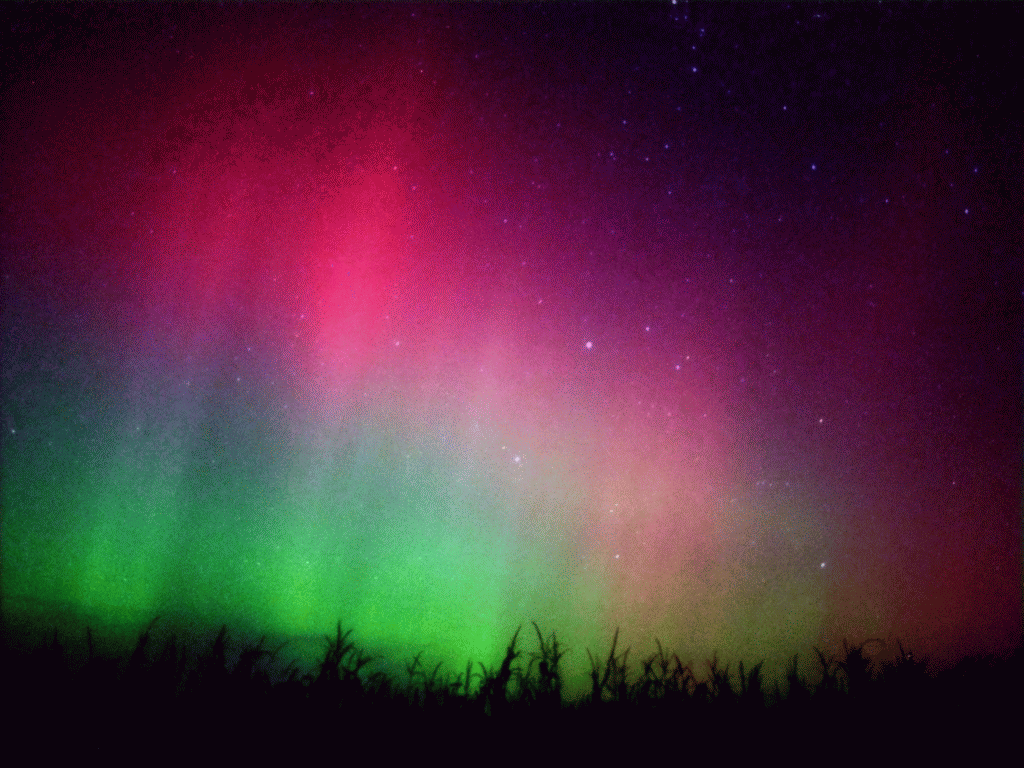
The color depends on whether or not the molecule being excited in oxygen or nitrogen and it depends on the orbitals an electron is jumping between (from orbital 2 back to 1, from 3 to 2, from 3 to 1, etc.).  Each of these jumps gives off a photon with a characteristic wavelength of visible light energy.  Oxygen emissions tend to be green or brownish-red while nitrogen emissions tend to be blue or red (if both are occuring, a purple color can be seen).  Below is a nice aurora picture showing green, red, and purple light.


Green, however, is the most common color seen in an aurora.  Here's an amazing time-lapse view from National Geographic of mostly-green northern lights over Norway.  Their curtain-like, shimmering shape is due to the charged particles moving along the lines of force of the Earth's magnetic field.


Below is an image of the aurora borealis from the International Space Station (ISS) on September 29 as it orbited over the midwestern U.S. at night. Note the prominant lights of Chicago and St. Louis near the center of the image (from NASA's Earth Observatory web site).


Under favorable conditions, auroras can be seen here in the Hudson Valley (I saw a red one during the last sunspot cycle).  So, hw can you know if a CME erupts during this sunspot cycle and there's a chance to view auroras here in the Hudson Valley (or wherever you live)?  I use SpaceWeather.com which has handy email elerts you can sign up for (in addition to having lots of other neat information).

Tuesday, November 15, 2011

Sunspots & the Earth

In previous posts, I introduced sunspots, discussed sunspot cycles, and tried to explain why the Sun has sunspots.  As a professor, I'm used to getting the "Why should we care?" argument from students.  My stock answer, expressed a bit more eloquently, is that it's fucking interesting.  But, in the case of sunspots, there are valid reasons why we, as a society, should be interested in them.  Check out this video.


This is a coronal mass ejection (CME) - a massive release of electromagnetic energy and ionized (charged) particles, mostly electrons and protons.  If the event occurs on the side of the Sun facing the Earth, electromagnetic energy from across the spectrum, long-wavelength radio waves to short-wavelength gamma rays, travel to Earth at the speed of light taking only 8.5 minutes or so to get here.  The stream of charged particles takes a bit longer to reach the Earth traveling, on average, about 500 km/s although sometimes reaching speeds of 2000 km/s.  Since the Sun is 150 million km away, it will take the charged particles anywhere from 1-4 days to arrive (depending on their speed).

These eruptions of energy on the Sun are associated with active regions - in other words sunspots.  They're not well understood but are thought to occur when lines of magnetic force break and reconnect releasing stored energy.  As much energy as a billion hydrogen bombs!

What are the consequences of this here on Earth?

Fortunately, here on Earth, we're shielded from much of the dangerous electromagnetic radiation (gamma rays and x-rays) and high-energy charged particles by the Earth's atmosphere and magnetic field.  Future astronauts on the surface of the Moon, or traveling on a ship to Mars, could get radiation poisoning or even be killed by such events (astronauts aboard the International Space Station are in a low-Earth orbit and still somewhat shielded from such events).

OK, you're thinking, I'm not planning a trip to Mars anytime soon so what's the worry?  The problem is that with a large enough CME, our atmosphere and magnetic field become a bit overwhelmed and there are effects here on Earth - some harmless and some more serious.

Our Earth has a magnetic field generated by the rotation of liquid iron in the outer core.  This field normally deflects away the constant stream of charged particles from the Sun (the solar wind).  This solar wind compresses the Earth's magnetic field on the side facing the Sun and stretches it out on the far side into a tail.


During a CME, so many charged particles (ions) interact with the magnetic field that some are able to leak down toward the Earth in the vicinity of the north and south magnetic poles.  Some get trapped in a doughnut-shaped ring called the Van Allen radiation belt and others spiral into the upper atmosphere (called the ionosphere).  These results in auroras.


More on auroras in a bit while we first take a short digression and talk about satellites and power grids...

Satellites are greatly affected by the charged particles released during a CME.  Most satellites don't orbit in the vicinity of the Van Allen belt, but those that do need to have their electronic components radiation hardened to survive.  Satellites in higher orbits are susceptible to damage from the high-energy particles from CMEs.  High energy electrons can physically damage the electronics and solar cells of satellites and even scramble the data stored in computer chips.

Large CME events can also compress the magnetosphere (the magnetic field "bubble" around the Earth) leaving the satellite outside of the protection of the magnetic field and more vulnerable to damage.  In addition, since satellites often use the Earth's magnetic field for guidance, this can disrupt their attitude control systems.  In 1997 and 1998, during the last sunspot cycle, a number of satellites were damaged from CMEs including the AT&T Telstar 401, PanAmSat Galaxy IV, and several Motorola Iridium satellites.  Almost a billion dollars in insurance claims were paid out in 1998 for satellite failures in orbit.

Low-Earth orbit satellites can also suffer from CMEs.  During a CME, the added energy into the Earth's atmosphere causes it to expand.  This creates increased frictional drag on these satellites reducing their orbital life-span.

There is another effect CMEs can have as well.  Large CMEs can induce currents in electrical lines here on Earth.  In March of 1989, two solar cycles ago, a large CME caused the power grid in Quebec to go down resulting in six million people losing power.  Are we still vulnerable 20+ years later?  More so than ever - check out these images from a recent study of this issue (click on the images to enlarge and read the captions).


It's theoretically possible for a large CME to knock out half of the U.S. power grid for weeks to years!  Think about that when wondering if it's worthwhile funding scientific research of the Sun.

Next time I'll post about auroras but for now I'll leave you with some information about the solar "superstorm" or 1859 (thought to be a once in every 500 years event).

On September 1, British astronomer Richard Carrington observed a large CME erupt from the Sun which took only 18 hours to reach the Earth (a velocity for the particles of over 2,000 km/s).  This triggered a massive geomagnetic storm on Earth resulting in auroras seen around the world (most notably down in the Caribbean!).  There were reports of people here in the Northeast being able to read newspapers by the light of the auroras at night.  Telegraph systems throughout the world failed.  Sparks flew from wires, operators received electrical shocks, and telegraph paper even caught fire.

Such an event today, in our electrified, wired world, would be literally catastrophic.