Sunday, January 22, 2012

The Magic of Reality

I recently read (from the library) The Magic of Reality: How We Know What's Really True by Richard Dawkins (2011, Free Press).  Dawkins, of course, is probably better known for his outspoken atheism and skepticism than he is for his scientific work as an evolutionary biologist and former professor at Oxford University.

The subtitle "How We Know What's Really True" best expresses the aim of this book.  Dawkins begins the book with a discussion of the difference between reality and magic (the supernatural) and comes down, not surprisingly, on the side of naturalism - science is the only valid way to examine and learn about the natural world.  As such, it's a very good introduction to how science operates and works but will obviously trouble those who would argue that there's more to the physical world since he doesn't shy away from including mainstream religion with other false ideas.

Throughout the book, Dawkins introduces a scientific question - Where did people come from? Why are there seasons? How do rainbows form? What causes earthquakes? - and then gives some culture's mythological explanation for the phenomenon (sometimes, the mythological explanation he provides is from the Bible).  This is followed by the scientific explanation of the phenonomon showing, of course, how it's far more reasonable and useful than the myths.

While the book is described as for being of people of all ages, it's really written more like a book aimed for children. That's not to say adults would not get something from this book since most adults have no freaking idea why the Earth experiences seasons or how evolution works, but it does have the tone of a book for children.  Given the vocabulary used and concepts discussed, the ideal age group for this book would probably be bright tweens.  Assuming, of course, Dawkins saying stories about Adam and Eve in the Garden of Eden are myths on par with Quetzlcoatl, Zeus, and Ganesha doesn't offend you.

The thing I liked best about this book are the awesome illustrations on every page by Dave McKean. It would be worth getting the book just for these.  Here are some examples (grabbed from the Amazon page for the book) below:

Saturday, January 21, 2012

Geology Tattoos?

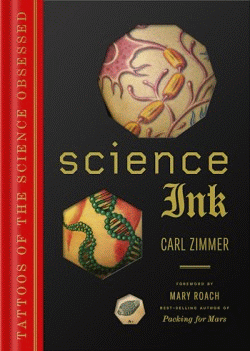
On this snowy Saturday morning (first significant snow here since last Halloween!), I was listening to an archived version of NPR's Science Friday from January 13.  They were interviewing Carl Zimmer about his Science Ink: Tattoos of the Science Obsessed book.

Zimmer, a science writer, started collecting images of science-themed tattoos on his blog (The Loom).  This eventually led to a book (that's how to write a book, ask people to submit all the material you need).  Here are some examples.  They're interesting to look at some are pretty neat.

Anyway, I'm mentioning this because when the host Ira Flatow asked Zimmer what types of tattoos he needed more images of, Zimmer answered geology related tattoos!

It seems to me there are a lot of possibilities there...  Interesting extinct organisms like Anomalocaris.  You could tattoo a globe showing Pangaea.  A crystal form.  Maybe a simple rock hammer (Zimmer mentioned an archaeologist who tattooed a trowel on themselves).

I don't have any tattoos (I'm not a very trendy person), but who knows.  Maybe my current mid-life crisis will lead to a cool tattoo after a few beers some evening.

Friday, January 20, 2012

Teachers & SAT scores

I obtained the following information from the interesting EducationRealist blog.

Facts like the following are sometimes used to claim K-12 teachers aren't too bright, on average:

Students who indicated that education was their intended major earned a combined math and verbal score of 967, about 0.31 standard deviations below the average of 1,017, meaning the 38th percentile in a standard normal distribution.

Of course, not all education majors become teachers (and shouldn't become teachers!).  Less than half make it through to certification and landing a teaching job.

Here's something a little more telling - SAT verbal and math scores, compared to average scores, for different groups of actual teachers.

Teachers, on average, have pretty good verbal skills.  Not so great in math unless you're a math or science teacher (not surprising).  What is surprising is how poorly some groups score.  Physical education majors don't do so well reinforcing the stereotype of the dumb gym teacher.  Special education teachers don't do so well either.  I know very little about special education so I can't comment one way or another.

What is sad is the low scores shown by elementary education teachers.  These are the teachers that come into contact with every single kid in the school system when the children are at a very impressionable age and learning the fastest.  It's not just babysitting.  Too bad elementary education teachers aren't of a higher caliber.

Here's another tidbit from the Gene Expression blog expanding upon this data.

As a generalization, the SAT scores of whites who end up in K-12 teaching aren't much different from the larger population SAT scores of college-bound seniors.  With Asians, the best seniors definitely don't go into K-12 teaching.  With blacks, K-12 teachers are drawn from the highest-scoring seniors.  Definite cultural differences at play here.  No comments, just found it interesting.

Data's great.  Too bad educational "reformers" typically ignore it (peruse the EducationRealist blog for many examples).

Wednesday, January 18, 2012

Blocked by SOPA/PIPA