Bizarre post over at The Geology P.A.G.E. titled "The Healing Power of Rocks" by Bridget Sandorford. Here's an example of her wisdom when discussing amethyst:
Many people use amethysts to help them recover from an addiction. It is also used to help people who are struggling with insomnia. It can give you an energy boost when you wear it and provide a soothing effect if you are overwrought about something. It has been used to help during pregnancy and to help fight chronic fatigue syndrome.
Amethyst is a relatively common purple variety of quartz (SiO2). It's a mineral, by the way, not a rock.
Did you know that the word "amethyst" comes from the Greek roots ἀ ("not") and μέθυστος (methustos or "intoxicated")? The ancient Greeks and Romans believed amethyst would protect them from getting drunk. Next Friday, I'll grab some from the lab before heading down to the local tavern after work and see if it helps.
This kind of nonsense has been around for a long time. It's called sympathetic magic. Amethyst is purple, wine is made from purple grapes, so amethyst must have some effect with wine (there's my problem, I don't drink wine but rather beer - I need a brown mineral).
Similarly, rusty red hematite (Fe2O3) is thought to have some effect on blood ("Hematite is good for any blood disorders...").
Check out the piece of nephrite jade below. It looks a little like a kidney, hence the name λίθος νεφρίτίκος (lithos nephriticos or "kidney stone" in Greek).
Must be good for kidney ailments! And, yes, that's what New Age crystal healers still claim. Any evidence to back up such claims? Not one fucking iota of evidence.
Want to use stones for healing? Powder up some limestone when you're having reflux (or pop a Tums, same difference). I heard cheery yellow orpiment is good for depression...
Just kidding, folks. If any of you dumbasses try to take orpiment, keep in mind that it's arsenic sulfide (As2S3) and not very good for you at all (even though it's all natural). It will, however, cure your depression. Permanently.
Monday, February 6, 2012
Saturday, February 4, 2012
Spring's coming...
Early this morning, February 4 at 1013 UTC (5:13 am EST), was an astronomical cross-quarter day - a half-way point between the winter solstice (December 22, 2011 at 0530 UTC) and the vernal (spring) equinox (March 20, 2011 at 0514 UTC).
I've written before about how this astronomical event has been associated with traditional holidays like the Celtic Imbolc, the Germanic groundhog day, and the Christian Candlemas.
For my midlatitude location (41° 52' N, 074° 06' W, rounded to the nearest minute), the Sun rose at 07:21 am (all times are in EST) and set at 4:29 pm giving us only 9 hours of daylight. Today, the Sun rose at 07:06 am and will set at 5:15 pm, adding another hour of daylight. By the spring equinox, sunrise and sunset will be at 05:59 am and 6:09 pm for 12 hours of daylight (equinox literally means "equal night" because it's the time when day and night are equal lengths at 12 hours each).
As someone who's mood is always affected by the loss of daylight winter brings, I always start to feel good this time of year and as someone who likes to spend time outside (without being bundled up against the cold), I really look forward to the coming arrival of spring.
Go outside and look around. As this month advances, you'll start to see some of the signs of reawakening of plants and animals (especially if this unseasonably warm weather continues here in the Hudson Valley).
I've written before about how this astronomical event has been associated with traditional holidays like the Celtic Imbolc, the Germanic groundhog day, and the Christian Candlemas.
For my midlatitude location (41° 52' N, 074° 06' W, rounded to the nearest minute), the Sun rose at 07:21 am (all times are in EST) and set at 4:29 pm giving us only 9 hours of daylight. Today, the Sun rose at 07:06 am and will set at 5:15 pm, adding another hour of daylight. By the spring equinox, sunrise and sunset will be at 05:59 am and 6:09 pm for 12 hours of daylight (equinox literally means "equal night" because it's the time when day and night are equal lengths at 12 hours each).
As someone who's mood is always affected by the loss of daylight winter brings, I always start to feel good this time of year and as someone who likes to spend time outside (without being bundled up against the cold), I really look forward to the coming arrival of spring.
Go outside and look around. As this month advances, you'll start to see some of the signs of reawakening of plants and animals (especially if this unseasonably warm weather continues here in the Hudson Valley).
Friday, February 3, 2012
Wood Fueled Cars
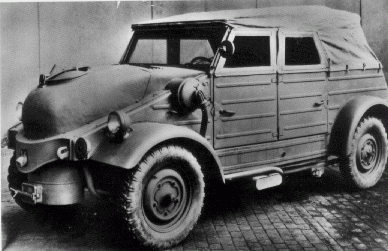
I listen to Car Talk each week on NPR and on a recent show a caller named Hans mentioned that when he was in Europe during World War II, he saw cars that ran on wood chips. They didn't burn the wood the steam, they just shoveled it into a special tank in the trunk of the car. He wondered how it worked but Bob and Ray had no idea. The following week a caller explained what Hans saw in Germany.
Turns out there were cars and trucks in Europe modified to run on wood gas during World War II as a result of severe fuel rationing. According to Wikipedia:
In Germany alone, around 500,000 "producer gas" vehicles were in use at the end of the war. Trucks, buses, tractors, motorcycles, ships and trains were equipped with a wood gasification unit. In 1942 (when wood gas had not yet reached the height of its popularity), there were about 73,000 wood gas vehicles in Sweden, 65,000 in France, 10,000 in Denmark, and almost 8,000 in Switzerland. In 1944, Finland had 43,000 "woodmobiles", of which 30,000 were buses and trucks, 7,000 private vehicles, 4,000 tractors and 600 boats.
So how does it work? Here's a diagram from Wikipedia:
Generally, you have a tank for wood (anything from logs to wood chips). The wood is heated and charred in the sealed container with limited oxygen input. Chemists call this process pyrolysis. When you burn wood in the presence of oxygen (a fireplace, for example), you produce gaseous H2O and CO2. In pyrolysis, with limited oxygen, you instead get H2 and CO - both flammable gases. The smoke is then filtered (to remove soot and tars - not necessary but results in cleaner emissions) and cooled (to increase flammability of the gases). It's then mixed with a little air and fed into a normal internal combustion engine (you don't really need to modify anything - it will power a standard car engine).
20% Carbon monoxide (CO)
18% Hydrogen (H2)
4% Methane (CH4)
8% Carbon dioxide (CO2)
50% Nitrogen (N2)
The energy content of wood gas is around 5.7 MJ/kg, compared to 44 MJ/kg for gasoline. It's certainly not as efficient (or convenient) as gasoline. But, hey, if times get bad and fossil fuels are in short supply, who knows, it might make a comeback!
Turns out there were cars and trucks in Europe modified to run on wood gas during World War II as a result of severe fuel rationing. According to Wikipedia:
In Germany alone, around 500,000 "producer gas" vehicles were in use at the end of the war. Trucks, buses, tractors, motorcycles, ships and trains were equipped with a wood gasification unit. In 1942 (when wood gas had not yet reached the height of its popularity), there were about 73,000 wood gas vehicles in Sweden, 65,000 in France, 10,000 in Denmark, and almost 8,000 in Switzerland. In 1944, Finland had 43,000 "woodmobiles", of which 30,000 were buses and trucks, 7,000 private vehicles, 4,000 tractors and 600 boats.
There are do-it-yourselfers around today who still tinker with these types of vehicles. I had never heard of this before and thought it was fascinating.
According to the website where the image was grabbed, the Volvo above can reach a maximum speed of 120 km/hr (75 mi/hr) and maintain a cruising speed of 110 km/hr (68 mi/hr). The "fuel tank" can contain 30 kg (66 lbs) of wood, good for a range of 100 km (62 mi). Not good for a cross-country vacation but comparable to electric cars used for short-distance commutes.
So how does it work? Here's a diagram from Wikipedia:
A. Wood, B. Fire, C. Air Inlet, D. Grating, E. Gases, F.Coarse Filter,
G. Filtered Gases, H. Radiator to Cool Gases, I. Cooled Gases,
J. Fine Filter, K. Wood Gas, and L. Air Mixing & Choke.
Generally, you have a tank for wood (anything from logs to wood chips). The wood is heated and charred in the sealed container with limited oxygen input. Chemists call this process pyrolysis. When you burn wood in the presence of oxygen (a fireplace, for example), you produce gaseous H2O and CO2. In pyrolysis, with limited oxygen, you instead get H2 and CO - both flammable gases. The smoke is then filtered (to remove soot and tars - not necessary but results in cleaner emissions) and cooled (to increase flammability of the gases). It's then mixed with a little air and fed into a normal internal combustion engine (you don't really need to modify anything - it will power a standard car engine).
The output from a typical wood gas system consists of the following:
20% Carbon monoxide (CO)
18% Hydrogen (H2)
4% Methane (CH4)
8% Carbon dioxide (CO2)
50% Nitrogen (N2)
The energy content of wood gas is around 5.7 MJ/kg, compared to 44 MJ/kg for gasoline. It's certainly not as efficient (or convenient) as gasoline. But, hey, if times get bad and fossil fuels are in short supply, who knows, it might make a comeback!
Thursday, February 2, 2012
What do faculty do?
I can't tell you the number of times an ignorant person has made a comment to the effect that teaching faculty have cushy jobs because we only work a couple of hours a day (e.g. today I taught from 8:40-10:00 and 11:40-1:00).
The first thing I ask people is if they've ever given a one-hour lecture before. Then I ask how long it took them to prepare it. Then I ask them to imagine doing 15 of them a week for four months. Write a few dozen assignments and a half dozen tests while you're at it. Grade them. Doesn't sound so easy now, does it?
As a matter of fact, given a shit-load of work dumped on me recently, I've been at the office until 8 pm on Monday, 7 pm on Tuesday, left "early" at 5:30 pm Wednesday, and 6:00 pm today. I have to be in before 8:30 most days since I have an 8:40 class. I also work in the evenings at home (primarily grading and course prep). And many weekends. A 9-5 job would be like a fucking vacation.
Faculty at our community college also do a hell of a lot more than simply teach. Here's a list I came up with off the top of my head. As a professor and department chair, I do pretty much everything listed below. I've probably forgetten a few things too.
Training to use technology (online course management system, school's computer system for registration)
Periodically entering dates of attendance and grades into school computer system for over 100 students
Keeping office hours (4 hours/week minumum)
Student advisement and registration (beyond required office hours)
Meeting with students who need assistance (informal – varying numbers of hours – sometimes all day long)
Writing recommendation letters for students
Textbook evaluation and selection (and meeting with textbook reps)
Assistance with course scheduling
Course assessment (required by our accrediting agency)
Syllabi revisions (most faculty get involved in this at some point)
Faculty Senate and Faculty Association (our union) Executive Committee service
Field trips (including Saturdays with no extra pay) and astronomical night observations
Student Club advisement and activities
Science Olympiad (hosted yearly at our college and a big deal for us in the science department)
Research (some faculty do research and publish at our College)
Grant writing (we have no full-time grant writer at our institution)
Public outreach (e.g. local lectures, presentations, etc.)
Community service (many clubs on Campus and their advisors do stuff for the community)
Service to the college community (e.g. One Book/One College presentations)
Real-world experience supervision (some classes work on outside projects for the community)
Recruitment and scheduling of speakers and performers (who do you think does that?)
Advisory board meetings
Periodic cleaning and maintenance of labs and equipment (somethings can’t be done by housekeeping)
Grading of math and English placement exams
Service on search committees (faculty & staff positions)
Extra committees (Chairs serve on several special committees)
Program revisions
Articulation agreements
Course revisions (additions/deletions)
Adjunct recruitment and hiring
Adjunct supervision and mentoring
Adjunct evaluations
Course scheduling
Supervision of Instructional Assistants and Lab Techs
Supervision of student aides
Collegian program supervision (college courses in local high schools)
Developing the yearly budget and strategic plan (a LOT of work)
Hiring new full-time faculty (writing job ads, screening CVs, setting up search committees)
Running department meetings
Purchasing equipment (entering in system, getting a P.O, ordering, delivery, invoice, etc.)
Dealing with random requests from the public
Ad hoc work at Dean’s request (numerous requests every semester)
All that for significantly less money than people with comparable degrees earn in the private sector.
I'm really not complaining, I generally like my job. Just don't fucking tell me I don't earn my pay.
The first thing I ask people is if they've ever given a one-hour lecture before. Then I ask how long it took them to prepare it. Then I ask them to imagine doing 15 of them a week for four months. Write a few dozen assignments and a half dozen tests while you're at it. Grade them. Doesn't sound so easy now, does it?
As a matter of fact, given a shit-load of work dumped on me recently, I've been at the office until 8 pm on Monday, 7 pm on Tuesday, left "early" at 5:30 pm Wednesday, and 6:00 pm today. I have to be in before 8:30 most days since I have an 8:40 class. I also work in the evenings at home (primarily grading and course prep). And many weekends. A 9-5 job would be like a fucking vacation.
Faculty at our community college also do a hell of a lot more than simply teach. Here's a list I came up with off the top of my head. As a professor and department chair, I do pretty much everything listed below. I've probably forgetten a few things too.
Job Duties of All Faculty at our Institution:
Course preparation (hundreds of lectures a semester, writing quizzes, writing exams, etc.)
Course grading (quizzes, exams, papers, assignments, labs, etc.)
Upgrading courses (in science, material changes every semester with new discoveries)
Professional development (reading journals, attending conferences, short courses, lectures, webinars, etc.)Training to use technology (online course management system, school's computer system for registration)
Periodically entering dates of attendance and grades into school computer system for over 100 students
Keeping office hours (4 hours/week minumum)
Student advisement and registration (beyond required office hours)
Meeting with students who need assistance (informal – varying numbers of hours – sometimes all day long)
Writing recommendation letters for students
Textbook evaluation and selection (and meeting with textbook reps)
Assistance with course scheduling
Course assessment (required by our accrediting agency)
Committee work (many faculty are on multiple committees)
Peer evaluation (most faculty at some point take part in faculty evaluation of a colleague)
Some Faculty Routinely Do More:
General Education course assessments (periodically required by SUNY)Syllabi revisions (most faculty get involved in this at some point)
Faculty Senate and Faculty Association (our union) Executive Committee service
Field trips (including Saturdays with no extra pay) and astronomical night observations
Student Club advisement and activities
Science Olympiad (hosted yearly at our college and a big deal for us in the science department)
Research (some faculty do research and publish at our College)
Grant writing (we have no full-time grant writer at our institution)
Public outreach (e.g. local lectures, presentations, etc.)
Community service (many clubs on Campus and their advisors do stuff for the community)
Service to the college community (e.g. One Book/One College presentations)
Real-world experience supervision (some classes work on outside projects for the community)
Recruitment and scheduling of speakers and performers (who do you think does that?)
Advisory board meetings
New student recruitment (e.g. Open House, high school visits)
Lab setup and takedown (this is beyond normal classroom hours)Periodic cleaning and maintenance of labs and equipment (somethings can’t be done by housekeeping)
Grading of math and English placement exams
Service on search committees (faculty & staff positions)
Some Faculty are Also Program Coordinators or Department Chairs:
Program review and assessment (required by SUNY)Extra committees (Chairs serve on several special committees)
Program revisions
Articulation agreements
Course revisions (additions/deletions)
Adjunct recruitment and hiring
Adjunct supervision and mentoring
Adjunct evaluations
Course scheduling
Full-time faculty supervision (complaints about faculty from students & administration comes to chairs)
Supervision of department secretariesSupervision of Instructional Assistants and Lab Techs
Supervision of student aides
Collegian program supervision (college courses in local high schools)
Developing the yearly budget and strategic plan (a LOT of work)
Hiring new full-time faculty (writing job ads, screening CVs, setting up search committees)
Running department meetings
Purchasing equipment (entering in system, getting a P.O, ordering, delivery, invoice, etc.)
Dealing with random requests from the public
Ad hoc work at Dean’s request (numerous requests every semester)
All that for significantly less money than people with comparable degrees earn in the private sector.
I'm really not complaining, I generally like my job. Just don't fucking tell me I don't earn my pay.

Subscribe to:
Posts (Atom)